History & Facts
A sourced encyclopedia entry for Huni. Every claim below carries a citation and is tagged Established, Disputed, or Not Confirmed — nothing is presented as settled that isn't. The Claims in Circulation section further down addresses claims that spread online without a traceable source, so you can check them against the record.
At a Glance
Who was Huni?
Huni was the last pharaoh of Egypt's Third Dynasty, Old Kingdom, whose reign the Turin King List credits at roughly twenty-four years, ending around 2613 BCE. His predecessor was most likely Khaba, and he was succeeded by Sneferu, who founded the Fourth Dynasty.
Was Huni a real historical figure?
Yes. Huni is attested on objects made during his own reign — a red granite cone from Elephantine and a magnesite bowl from South-Abusir — as well as later king lists including the Saqqara Tablet and the Turin King List, and a Palermo Stone reference to his mortuary cult.
Did Huni build the Meidum Pyramid?
This is a popular but rejected claim. Current Egyptological consensus holds the Meidum pyramid was Sneferu's own project from its inception, not one Huni began — no inscription at the site names Huni, while Sneferu is directly attested there.
What is Huni's Horus name?
Unconfirmed — an unusual gap for the period. Candidates proposed by Egyptologists include Khaba, Neb-hedjetnwb, and Horus-Qahedjet (from a Louvre stele of disputed authenticity), but none is securely established.
Where is Huni buried?
Unknown. No pyramid or tomb securely inscribed with his name has ever been found. Egyptologist Miroslav Bárta has proposed Mastaba AS-54 at South-Abusir as a possible connection, but this is a minority theory, not a confirmed identification.
Was Hetepheres I the daughter of Huni?
This has been proposed but is questioned by scholars — it is not a settled fact. See the Family Tree for the full evidence behind this and other disputed relationships.
Reign
Huni was the last pharaoh of the 3rd Dynasty, Old Kingdom, reigning to roughly 2613 BCE.
Source: Wikipedia; World History Edu
The Turin King List credits him with a ~24-year reign.
Source: Wikipedia; Ask Aladdin
Succession
His position as the last king of the 3rd Dynasty is fairly certain.
Source: Wikipedia
His reign marks the transition from the 3rd to the 4th Dynasty, immediately preceding Sneferu.
Source: World History Edu; Egypt United Tours
His predecessor was most likely Khaba, but the succession order at the end of the 3rd Dynasty is uncertain.
Source: Ask Aladdin; Wikipedia
Identity
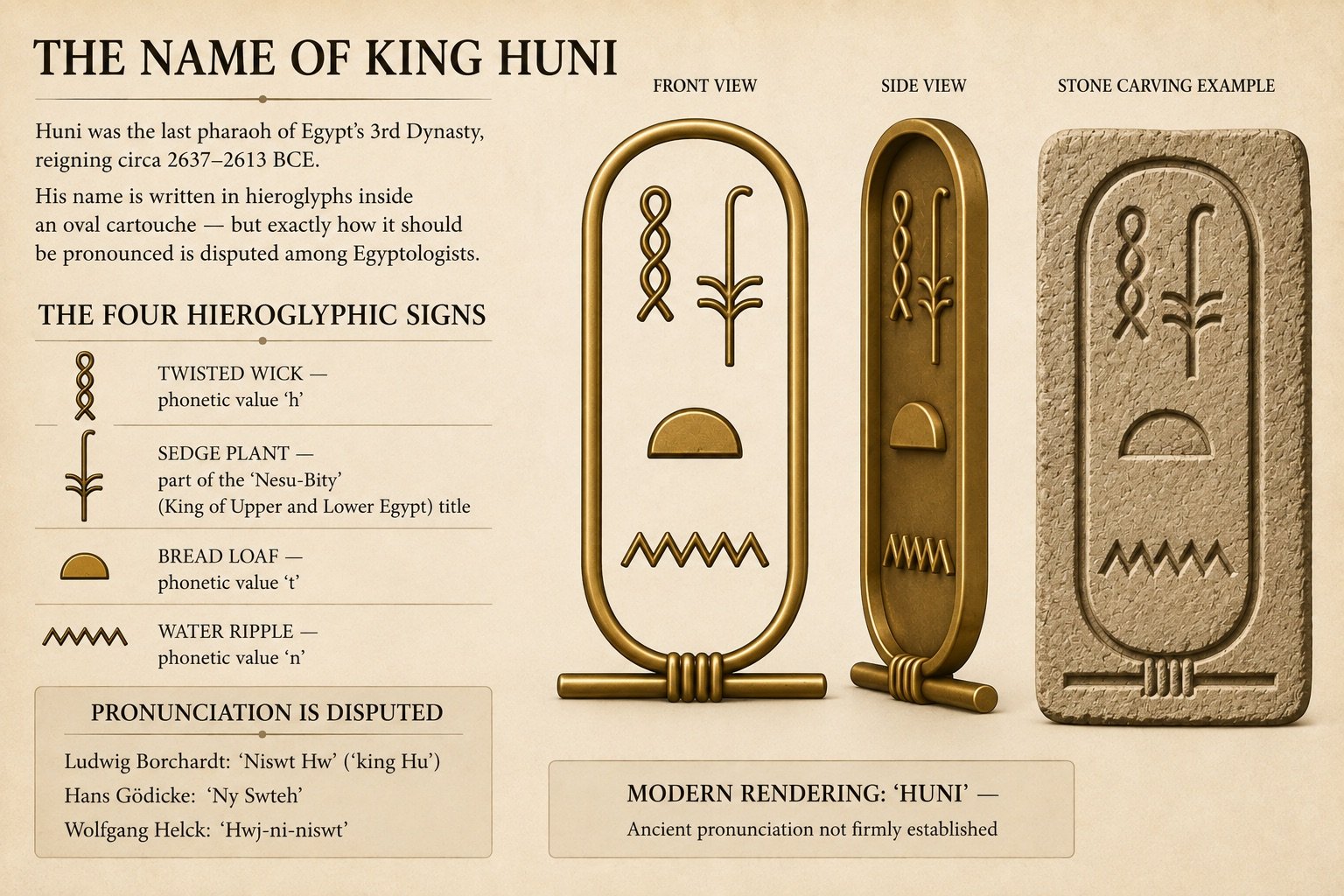
His Horus name — the name that identified every pharaoh as the living embodiment of the falcon god Horus, normally the most secure part of a king's identity — has never been confirmed for Huni, an unusual gap for the period. Proposed candidates include Khaba (which would make him the same person as the separately-attested king of that name) and Neb-hedjetnwb, "Lord of the Golden Crown" (per Peter Kaplony) — though Aidan Dodson argues that name belongs instead to the later, barely-attested king Bikheris. A third candidate, Horus-Qahedjet, comes from a contested Louvre stele — see the Artifacts page.
Source: Wikipedia: Khaba; Wikipedia: Qahedjet
His Hellenized name in Manetho's records was possibly "Aches" (per Barta), but this is unclear.
Source: Wikipedia
The Abydos King List, compiled centuries later under Seti I, omits Huni entirely and lists a "Neferkare" in his place — a name otherwise unknown to Egyptologists. One theory holds this was an alternate nomen (birth name) for Huni, but this is speculative and unconfirmed.
Source: Wikipedia: Huni
Family
Whether he was the biological father of Sneferu has been proposed but is questioned.
Source: Wikipedia
Burial
Despite an estimated 24-year reign, no pyramid or tomb securely inscribed with Huni's name has ever been found. His actual burial place is one of the open questions of Old Kingdom archaeology.
Source: Cross-checked across Wikipedia and academic literature on Third Dynasty pyramids
Czech Egyptologist Miroslav Bárta has proposed that Mastaba AS-54, a large official's tomb his team excavated at South Abusir, may be connected to Huni's own burial rather than an official's alone — based on the magnesite bowl bearing Huni's name found inside it. This is a minority theory, not a confirmed identification; over 100 other stone vessels in the same tomb belonged to its official occupant, not the king.
Source: Miroslav Bárta, "An Abusir Mastaba from the Reign of Huni"
Monuments
The Meidum pyramid is popularly attributed to Huni as builder, with completion credited to Sneferu — but current Egyptological consensus rejects this and holds it was Sneferu's own project from the start. See the Artifacts page for the full picture of monument attributions.
Source: Wikipedia; Cairo Top Tours (popular attribution)
Claims in Circulation
These claims turn up on general-history and tourism sites but could not be traced to Wikipedia, a museum/academic source, or any primary text we checked. We list them here, clearly marked, rather than let them fill gaps unchallenged.
The claim that Huni built a fortress on Elephantine Island to defend Egypt's southern border at the First Cataract circulates on a number of general-history and tourism sites, but we could not locate it in Wikipedia, in the academic literature on Elephantine, or in any primary source. The only securely attested Huni object from Elephantine is a red granite cone referencing a royal building there (see Artifacts) — which is not evidence of a fortress.
Source: Checked against Wikipedia: Huni and available Elephantine excavation literature; no corroborating source found
The claim that Huni began his career as a court official under Djoser before rising to become pharaoh also circulates online. Private individuals named "Huni" are genuinely attested in Third Dynasty tomb inscriptions, but standard Egyptological practice distinguishes them from the king, whose name is set apart in a royal cartouche — and no source we found demonstrates the official and the king were the same person.
Source: Checked against Wikipedia: Huni; no corroborating academic source found
Artifacts
Surviving artifacts include a red granite conical stele from Elephantine Island referencing the "Palace of the Headband of Huni," and a polished stone bowl from South-Abusir bearing the title Njswt-Bity ("King of Upper and Lower Egypt").
Source: World History Edu
Legacy
His name appears on the Palermo Stone (a 5th-Dynasty record), showing his mortuary cult persisted after death.
Source: World History Edu